SmartBirds

Photo: © Vladimir Trifonov
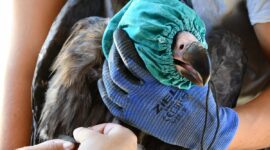
On 24 September, in the Eastern Rhodopes, the teams of the Bulgarian Society for the Protection of Birds (BSPB), Rewilding Rhodopes Foundation, and Green Balkans tagged seven Cinereous Vultures that arrived in Bulgaria from Spain in May.
The birds were fitted with rings and special GPS transmitters that will allow us to track their flights in real time. This data is invaluable for scientists and conservationists, helping us to better understand the behavior and adaptation of the birds, and to ensure their successful return to the wild in the Rhodopes.

Photo: © Vladimir Trifonov
So far, within the LIFE Rhodope Vulture project, a total of 33 individuals have been released in the region. The main goal is to restore the breeding population of the species in the Bulgarian part of the Eastern Rhodopes and to establish a new colony that will support the only existing natural colony of the Cinereous Vulture in the Balkans – in Dadia National Park, Greece.

Photo: © Vladimir Trifonov
The Cinereous Vulture – the largest bird of prey in Europe – disappeared as a breeding species in Bulgaria around 25 years ago. Today, thanks to international cooperation with the Spanish organization GREFA and the support of the EU’s LIFE Programme and Rewilding Europe, the species is being given a chance for a new future in the Rhodopes.
We thank all partners and the local community for their support. This is another step towards the comeback of the Cinereous Vulture in Bulgaria!

Photo: © Vladimir Trifonov
The reintroduction activities are part of the LIFE project, ” Restoration of the Cinereous vulture population and trophic chain in the Bulgarian-Greek cross-border region“,implemented on the Bulgarian side by the Bulgarian Society for the Protection of Birds in collaboration with Rewilding Rhodopes Foundation. The project (No. 101148254 — LIFE23-NAT-BG-LIFE Rhodope Vulture) is co-financed by the European Union’s LIFE program and Rewilding Europe. The Cinereous Vultures are provided by the Spanish NGO GREFA (Grupo de Rehabilitación de la Fauna Autóctona), which has long been working for the rescue and rehabilitation of injured wild birds.