 SmartBirds
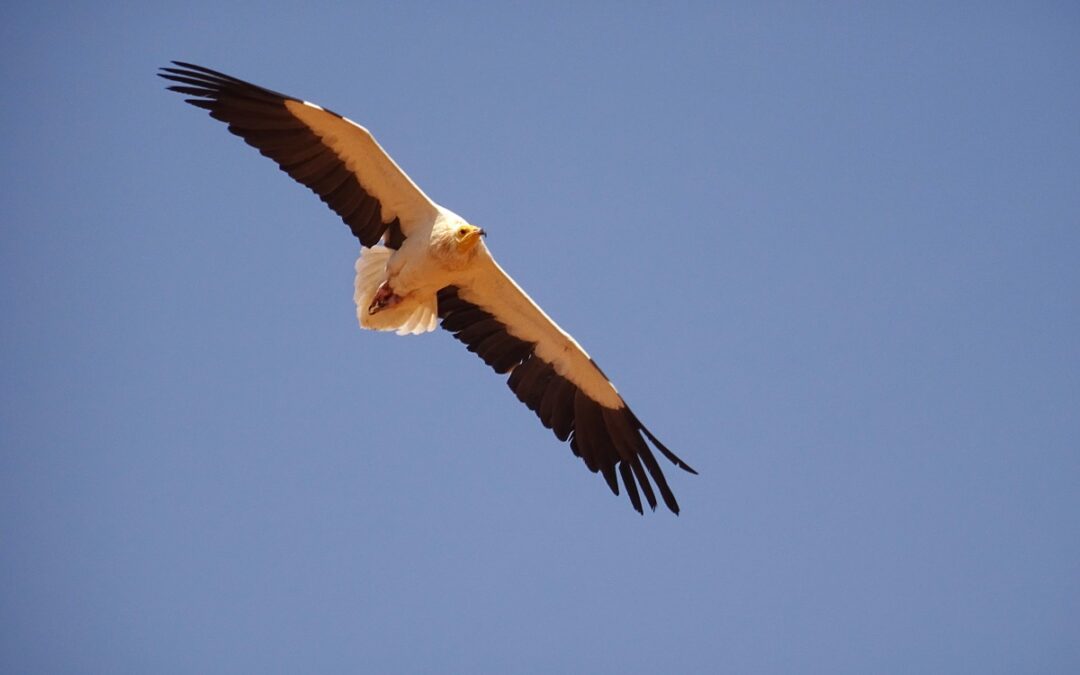
Photo: © Volen Arkumarev/BSPB
An international study involving experts from the Bulgarian Society for the Protection of Birds (BSPB/BirdLife Bulgaria) uncovers one of the most complex survival strategies in birds of prey.
A team of experts from the Bulgarian Society for the Protection of Birds (BSPB/BirdLife Bulgaria) has contributed to a new international study published in the Journal of Avian Biology, revealing how the Egyptian Vulture manages to balance three of the most energy-demanding processes in its life cycle – breeding, migration and feather moult.
The study is the result of a collaboration between scientists from five countries and brings together data collected over a decade from Egyptian Vulture populations across Europe, Asia and Africa. BSPB researchers contributed long-term monitoring data from the Balkan population, as well as information gathered from the species’ wintering grounds in Africa.
A continuous balance between three vital processes
For most birds, the annual replacement of feathers is essential because worn feathers reduce flight efficiency. In large raptors such as the Egyptian Vulture, however, moulting is an even more complex and critical process. These birds rely on perfectly functioning flight feathers to travel long distances every day while searching for food and during migration. As a result, replacing all flight feathers cannot be completed within a single year and instead takes place over several consecutive seasons.
At the same time, adult birds must undertake annual migrations covering thousands of kilometres between Europe and Africa while also successfully raising their young. This presents the Egyptian Vulture with a remarkable challenge: how to allocate its limited energy resources among these three essential life processes.
To answer this question, the researchers analysed 740 detailed moult cards from migratory, resident and partially migratory Egyptian Vulture populations. This is the largest study of moult in the species conducted to date.
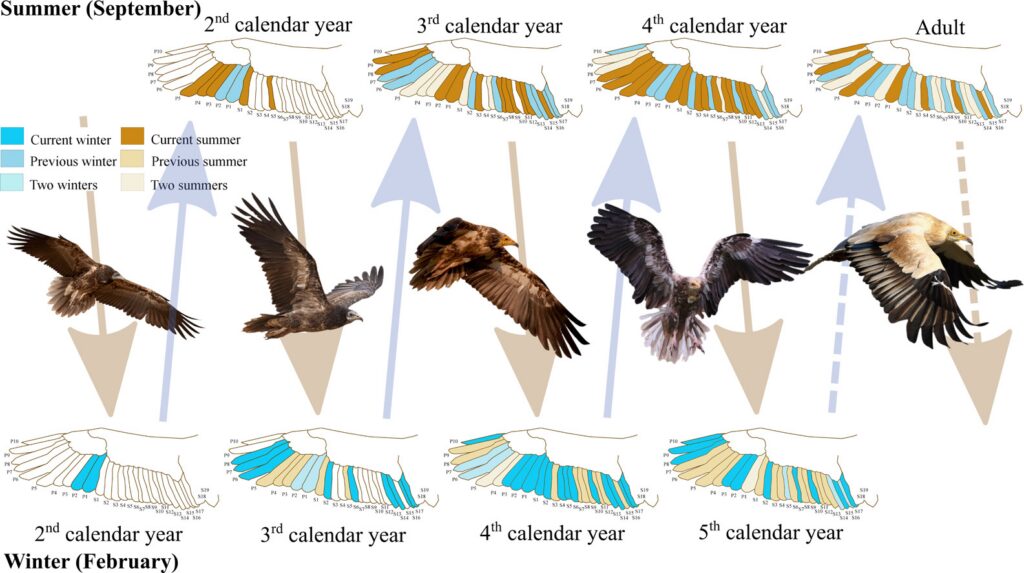
The results show that young birds begin replacing their flight feathers during their second calendar year and continue moulting almost continuously until they reach sexual maturity.
Adult birds follow a much more complex strategy. They do not moult during the early stages of chick rearing. Only in mid-summer, when the energetic demands of raising offspring decrease, do they begin replacing part of their flight feathers. Moult then continues during autumn migration and accelerates significantly once the birds reach their wintering grounds in Africa. Shortly before spring migration, adult vultures interrupt moult again to prepare for their long journey back to Europe.
As a consequence, for almost half of the year adult Egyptian Vultures do not replace a single flight feather. This strategy allows them to avoid overlapping three extremely energy-demanding activities: migration, breeding and feather replacement.
Migration determines the pace of moult
One of the study’s most interesting findings is that migratory behaviour has a strong influence on the rate at which birds replace their feathers.
Resident populations, such as those on the Canary Islands, begin moulting earlier and are able to replace a larger proportion of their feathers each year. In contrast, European migratory birds, which travel thousands of kilometres annually between Europe and Africa, replace fewer feathers because a substantial amount of their energy is devoted to migration. As a result, adults from these populations require almost two years to complete a full replacement of their flight feathers.
These findings demonstrate how finely tuned the Egyptian Vulture’s annual cycle is and how closely interconnected its different life-history processes are.
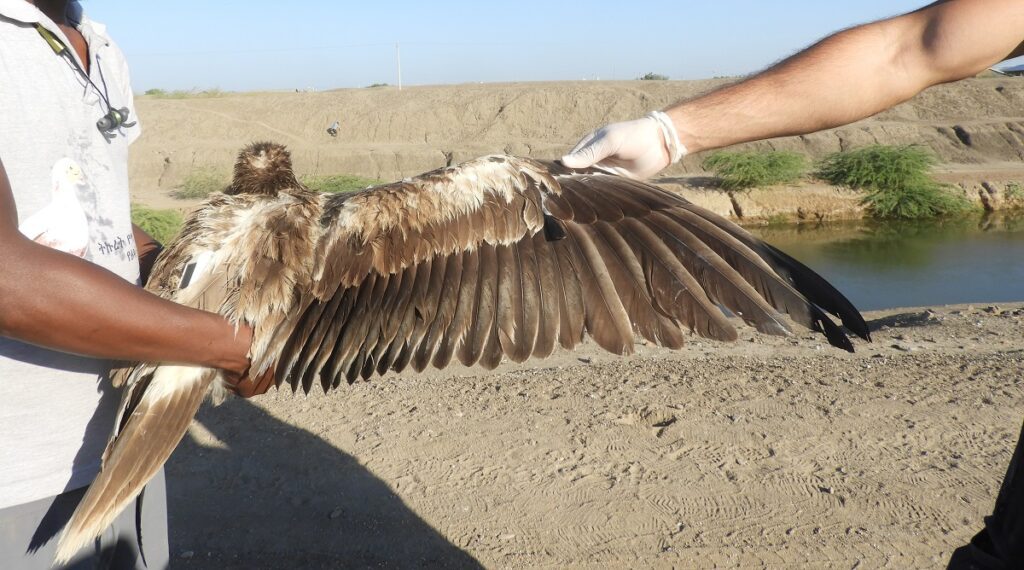
Photo: © Volen Arkumarev/BSPB
BSPB’s contribution
For more than two decades, BSPB has been collecting detailed data on the biology, behaviour and migration of the Egyptian Vulture. This long-term monitoring effort, combined with extensive international collaboration, made it possible to conduct such a comprehensive analysis.
The study not only advances scientific understanding of the species’ biology but also provides valuable information for planning future conservation actions aimed at protecting one of the world’s most endangered vulture species.


